Excuse me, what do you do?
May 11th, 2026
I’ve been thinking about my job a lot lately. I’m a mid-level Technical Writer at a U.S.-based software company with an office in Recife, which is where I live. Honestly, I’ve been questioning what I do—whether it’s still relevant or if it’s finally time to find something else. Maybe I should just sell handcrafted goods at the beach. I don’t know.
This question is always on my mind because, believe it or not, the topic even comes up when I’m just hanging out with my friends.
We play board games every other Friday, and every once in a while, I have to teach them a new one. To do that, I read the manual first and then explain the rules to the group. They always claim they can’t understand me and tell me I should explain it better. Sure, they’re usually all trying to talk over one another, but according to them, I’m the issue. To which I always respond, “If only that were my job.”
¯\(ツ)/¯
And you know what? It is (well… kind of…)!
But sometimes, even I don’t know exactly what my job entails—and I’m pretty sure other people don’t, either. Do I write? Do I test? Do I “own” the product? Do I talk to developers or other stakeholders? Do I draw diagrams, edit images, find and report bugs, or review other people’s work? The answer is usually: all of the above and more.
To my family and non-work friends, I simply say I work for a multinational software company and write the manuals for its products. It’s not 100% accurate, but it’s close enough.
To my colleagues at the office who aren’t on my direct team, I explain that I handle the technical documentation for the features they develop. In the process, I have to test those features to ensure they’re working; if they aren’t, I report the bugs to improve the product. It sounds important (and it is).
I imagine everyone else thinks I just… write… technical stuff. It’s in the title, right? Technical Writer.
That worries me. I can picture people thinking, “Well, anyone can do that. AI can replace them. We just give it commands and context, and it provides us with a well-written, organized, and methodical text.”
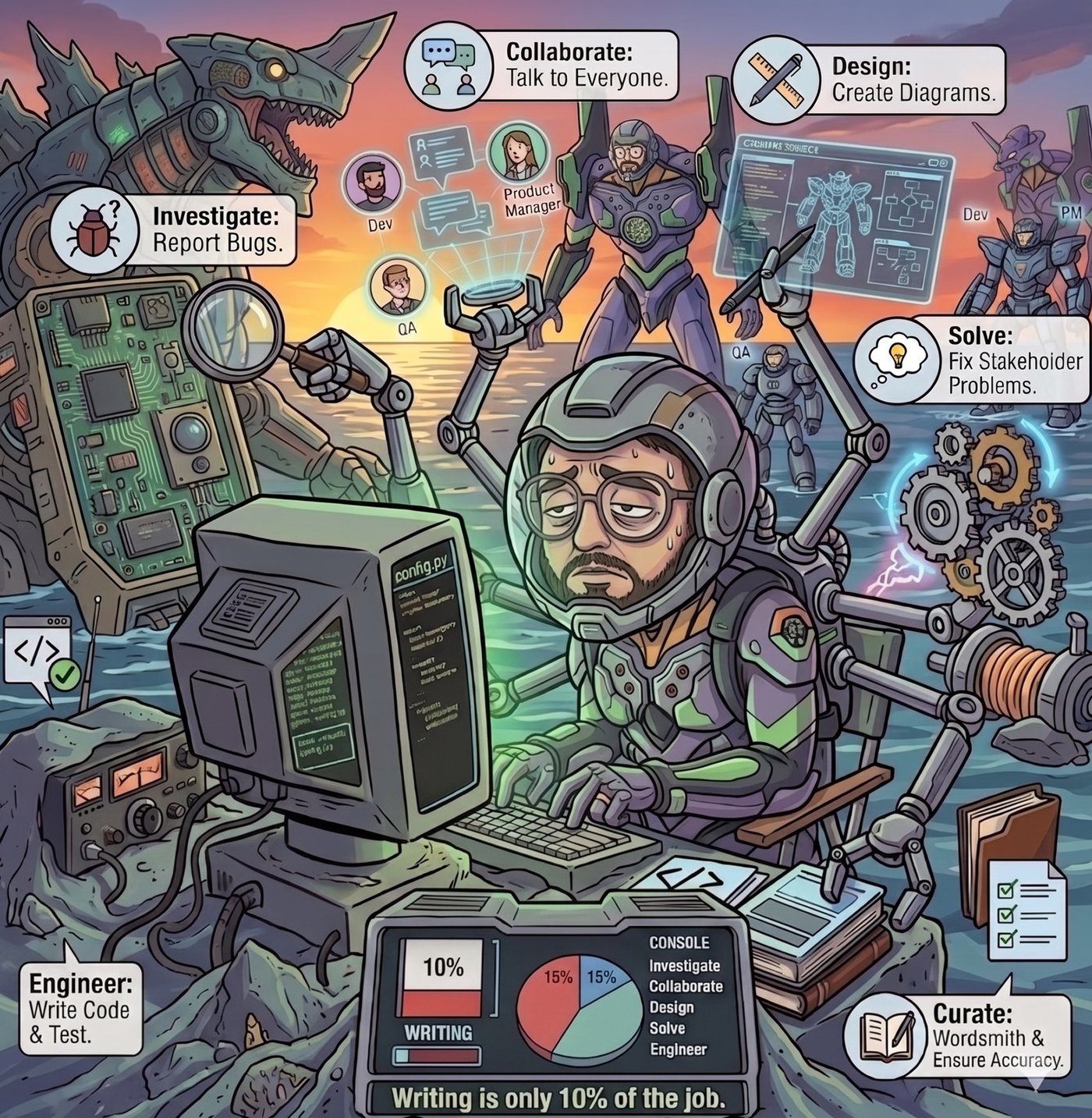
But do you know the funniest part? Writing is only 10% of the job. I’m just not sure people understand that. In reality, we:
- Collaborate: We talk to everyone across the organization.
- Engineer: We write code and test features to see how they actually behave.
- Investigate: We ask the hard questions and help improve the product from the inside out.
- Design: We create diagrams and edit images.
- Curate: We wordsmith material and ensure everything stays up to date.
- Solve: We listen to stakeholders who bring us problems that need fixing.
And we don’t do this for just one or two teams with a limited scope. We do it for multiple teams simultaneously, switching contexts every hour—sometimes even more frequently. We have to remember everything, know where the “bodies are buried,” and find information instantly, all while maintaining a rigid attention to detail and perfect consistency.
So, whenever I’m strolling through the office, heading to the restroom, or grabbing a drink at the water cooler, I’m not just “taking a break.” I’m calculating the what, how, where, and when of the documentation swirling around my head. Meanwhile, I’m trying to keep the emotions in my brain from going into total overdrive, like a scene straight out of Inside Out.
Yep, it’s definitely not easy being a technical writer.